
Is Monk Fruit Keto-Friendly? How to Choose the Right Blend for Baking and Drinks
Jump to...
Introduction
Yes, monk fruit sweeteners can fit into keto baking. We use monk-fruit blends in plenty of Butter Together desserts.
The confusing part is that “monk fruit sweetener” can mean several very different products. If your recipe calls for powdered sweetener and the bag in your cupboard is a granulated erythritol blend — or a bottle of concentrated liquid drops — that difference matters more than the words on the front.
The trap is that a bag can be right in one way and wrong in another. It can be as sweet as sugar cup for cup and still not act like sugar — still refuse to dissolve into a glaze, still sit gritty on top of a lemon bar. Matching the sweetness is the easy half. What the sweetener does once it is in the bowl is the half you taste.
So it is worth knowing what is actually in your bag before you measure out of it. Here is how to tell the products apart, and how to work out whether the one in your cupboard suits what you are making.
”Monk Fruit Sweetener” Is Not One Ingredient
Monk fruit — Siraitia grosvenorii, also called luo han guo — is sweet because of compounds called mogrosides. The FDA classes the extract as a high-intensity sweetener and notes that, depending on its mogroside content, it is 100 to 250 times sweeter than sugar. The agency has not questioned the safety conclusions submitted for it.
At that strength, pure extract is not a cup-for-cup stand-in for sugar. A whole recipe’s worth of sweetness is a very small amount of it, far less than the sugar it replaces.
Manufacturers bulk it out for that reason. They mix that small amount of extract with an ingredient that has volume, and that ingredient — not the monk fruit — is what determines how the product measures, how it dissolves, whether it browns, and what the nutrition panel says.
So the useful question in the aisle is not “is monk fruit keto?” but “what is in this bag, and what is it for?”
Read the Ingredient List Before the Nutrition Panel
Turn the package over. The first ingredient is usually the bulking agent, and the monk fruit extract is near the end.

That is the whole thing in one bag. The front of this one names the monk fruit and mentions erythritol in a line a quarter the size; the ingredient list puts erythritol first, because erythritol is most of what is in there.
These are the five products our recipes are written with, and what separates them:
| Product | Bulked with | Form | Job it does |
|---|---|---|---|
| Lakanto Classic | Erythritol | Granulated, white-sugar texture | Creaming into butter, sweetening batters |
| Lakanto Powdered | Erythritol | Fine powder | Glazes, frostings, dusting |
| Lakanto Golden | Erythritol | Granulated, brown-sugar style | Caramel notes, coatings |
| Besti | Allulose | Granulated | Batters and coatings; browns more readily |
| Lakanto Liquid | Nothing — it stays concentrated | Drops | Sweetening liquids |
The nutrition panels follow from that bulking agent rather than from the monk fruit. Lakanto’s Classic declares 8g of total carbohydrate per 2-teaspoon serving, all of it sugar alcohol. Besti declares 4g per teaspoon, all of it allulose. The liquid extract declares no carbohydrate at all per 3–4 drop serving, because there is no bulking ingredient in it to declare.

One brand, three products, measured against a teaspoon, a quarter cup and a drop. Comparing carbohydrate numbers between them without first comparing what the serving size is tells you nothing at all — and 30g of carbohydrate on the powdered bag is not a worse product, it is a bigger scoop.
Labels shown were checked in September 2026. Formulations and panels change, so read the bag you actually buy.
The Forms Do Genuinely Different Jobs
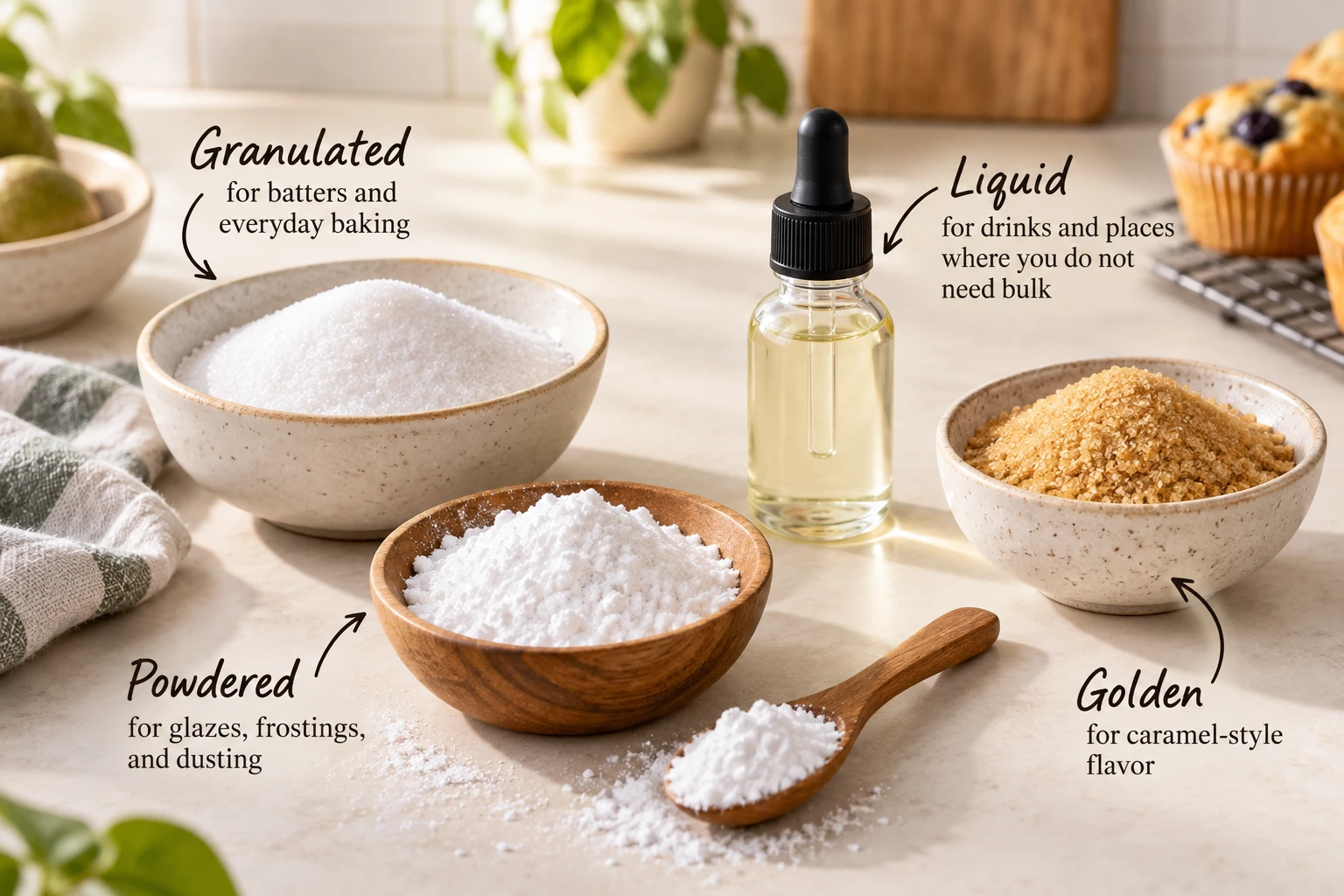
Here is what that looks like across our own recipes — which form goes where, and what it is doing there.
Granulated blends fill the space sugar would have filled. They measure by volume and cream into butter much as granulated sugar does, so half a cup is still half a cup of something. What happens to that batter afterwards — whether it browns, whether it sets firm — is a separate question, and the answer comes from the bulking ingredient rather than the monk fruit. Two granulated bags can measure the same and still not bake the same. Our Keto Lemon Bars use half a cup of the granulated Lakanto Classic in the filling.
Powdered suits anything that has to disappear. The same lemon bars finish with a dusting of the powdered version, which is a different job from the half cup in the filling. A dusting sits dry on a cooled surface with nothing to dissolve it, so granulated crystals can stay gritty there. Our Keto Lemon Pound Cake makes the same point about glaze: powdered is what dissolves into a smooth drizzle. Plenty of our recipes call for both forms in the same bake, in different places.
Golden suits caramel-leaning work. It is the brown-sugar-style product, and it goes where a molasses note belongs: our Best Keto Candied Pecans use half a cup of it in the coating, and our Sugar-Free Pecan Pralines lean on the same character.
Allulose browns where erythritol hangs back. Besti is bulked with allulose rather than erythritol. It browns and caramelizes more readily, and it does not leave the cooling sensation erythritol can. Our Keto Cinnamon Sugar Pork Rinds use it in the cinnamon coating.
Liquid works especially well in drinks. There is no bulk in it, so there is nothing to go undissolved at the bottom of a glass. Our Keto Pumpkin Cheesecake Shake uses drops. It will sweeten anything that does not also need the sweetener to take up room — what it cannot do is fill the cup a batter is expecting, which is why you will not find it in our cakes.
Can I Swap One Monk Fruit Sweetener for Another?
Sometimes. Work through it in this order:
- What form does the recipe name? If it says powdered, it usually means the texture, not just the sweetness.
- Is it bare extract, or a blend with bulk in it? Do not measure bare extract by volume against a recipe written for a blend. At 100 to 250 times the sweetness of sugar, a spoonful of extract is nowhere near a spoonful of blend.
- What does your package say about replacing sugar? Lakanto Classic and Besti are both sold as 1:1 sugar replacements for sweetness, and they say so on the bag. That still does not make them swappable everywhere, because erythritol and allulose brown, set and crystallize differently. Sweetness and behavior are two different questions, and another brand may be a different strength again.
- Is the sweetener only there to be sweet? If it is also filling out the batter, browning, giving a caramel note, or setting into a coating, changing the form changes more than the taste.
- Is the recipe built around one specific product? When a recipe card names a brand and a form, its amounts and its Nutrition Facts panel belong to that product. Before you swap, ask what that form is there to do — dissolve, brown, set — because that is the job your replacement has to take over.
The short rule: do not assume cup-for-cup unless the bag in your hand says so.
Erythritol and Allulose: Why the Blend Changes the Math
Two differences that show up while you are cooking.
Erythritol is a sugar alcohol. It appears on the nutrition panel under total carbohydrate and is then declared separately as a sugar alcohol, which is why a bag can show 8g of carbohydrate and still be sold as a sugar-free product — the carbohydrate and the sugar alcohol are the same 8g counted once and then itemized. It also has a cooling effect on the tongue that is more noticeable in something uncooked, like a frosting, than in a baked cake. It can recrystallize as things cool, which is part of why glazes want the powdered form.
Allulose is a rare sugar that is labeled differently, and it behaves differently in the pan: it browns and caramelizes more readily than erythritol, and it does not bring the cooling effect. Manufacturers describe granulated allulose blends as working in both crisp and soft baked goods, so this is something to cook around rather than a shorter list of things you can make.
Both are there to fill the space sugar would have taken up. Which one your bag uses is printed on the back.
Which Recipes Use Which Form
If you have one product and want to know what to make with it:
- Granulated (Lakanto Classic, Besti): Keto Lemon Bars, Keto Lemon Cookies, Keto Coffee Cake, Low Carb Carrot Cake
- Powdered: Keto Lemon Pound Cake glaze, Best Keto Mini Cheesecakes, Low Carb Peanut Butter Frosted Cupcakes
- Golden: Best Keto Candied Pecans, Sugar-Free Pecan Pralines, Keto Brownies
- Liquid: Keto Pumpkin Cheesecake Shake, Sugar-Free Keto Lemonade
Frequently Asked Questions
Is pure monk fruit the same as monk fruit sweetener?
No, and the difference matters in the bowl. Pure extract is a high-intensity sweetener that the FDA describes as 100 to 250 times sweeter than sugar, so it is not a cup-for-cup stand-in and is used in far smaller amounts than a recipe’s sugar quantity. Most retail products sold as “monk fruit sweetener” are mostly a bulking ingredient — usually erythritol or allulose — with a small amount of extract in it. The bulking ingredient is what determines how the product measures and behaves.
Does monk fruit have carbs?
The extract itself contributes essentially none at the amounts used, but the packaged product may well declare carbohydrate on its panel — and that number belongs to the bulking ingredient. Lakanto’s Classic lists 8g of total carbohydrate per 2-teaspoon serving, all of it declared as sugar alcohol. A liquid extract with nothing bulking it out lists none. Read the panel for the product you own rather than assuming a category figure.
Why does my monk fruit sweetener contain erythritol or allulose?
Because something has to fill the cup. The extract is far too concentrated to measure into a recipe on its own, so manufacturers mix a small amount of it with an ingredient that has volume. Erythritol and allulose are the two most common choices. They are not fillers in the dismissive sense — they take up the room sugar would have, which is why a blend can be creamed, dusted, or melted at all.
Can I replace powdered monk fruit with granulated?
Not where the texture is the point. A glaze, a frosting, or a dusting needs the sweetener to dissolve or sit invisibly, and granulated crystals can stay gritty in all three.
Going the other way, into a batter, use the form the recipe names rather than treating the two as interchangeable. How sweet a product is comes from its own stated conversion to sugar, not from how the two forms compare in a measuring cup, so check what your package says about replacing sugar and about the form you are using, and follow that.
Is a monk fruit blend a 1:1 substitute for sugar?
Some blends are, for sweetness, and they say so on the package — Lakanto Classic and Besti both do. That comes from what the maker put in the bag, not from the monk fruit. And it only covers the sweetness: two bags can both replace sugar cup for cup and still not behave the same in a pan, because erythritol and allulose brown, set and crystallize differently. Bare extract is a separate case again, at 100 to 250 times sweeter than sugar by weight, so measuring it by volume against a sugar amount would be a serious mistake.
Why did my frosting or dusting turn gritty?
The usual suspect is the granulated form where the recipe wanted powdered. Granulated sweetener is built to have the body of sugar, and in a cold application there may not be enough heat or moisture to dissolve those crystals fully — which is why the recipe asks for powdered. Erythritol-based products can also recrystallize as a glaze cools, which shows up as a faint sandiness the next day. Use the powdered version wherever the recipe says powdered — that is what it is for.
Can I use liquid monk fruit in a baking recipe?
Only where the sweetener has nothing to do but taste sweet. Drops are sweetness and nothing else — no volume, no bulk, no browning — so a cake or cookie recipe expecting half a cup of granulated sweetener comes out wrong unless something else fills that half cup. Liquid is at its best in drinks and shakes, where there is nothing to go undissolved at the bottom of the glass.
Does every monk fruit product taste the same?
No. Most of what you taste is the bulking ingredient rather than the monk fruit. Erythritol-based blends can leave a cooling sensation on the tongue, which is more noticeable in a frosting or a cold drink than in a baked cake. Allulose-based blends tend not to do that. Palates differ enough on this that it is worth trying a product in something small before committing it to a birthday cake.
The Bottom Line
“Monk fruit” on the front does not tell you how the bag will behave. The form and the bulking ingredient do.
Whether it measures like sugar, dissolves into a glaze, browns in a skillet, or sits gritty on top of a lemon bar comes down to what is doing the bulking — not to the monk fruit it is named after. So check which form the recipe asks for, turn your own bag over and see what it actually is, and if the two do not match, work out what the recipe was counting on that form to do before you swap it.
More From Butter Together Kitchen
-
The Best Alcoholic Drinks on Keto (and What to Skip)
Drinks, Health August 23, 2026 -
Keto Fruit Pizza with a Sweet Fathead Crust and Three Berries
Sweets August 30, 2026 -
Are Pork Rinds Keto? Carbs, Flavored Bags, and How to Use Them
Guides, Health, Ingredients September 22, 2026 -
How To Start The Keto Diet
Guides, Health December 13, 2018